A manager walks through the office on a Tuesday afternoon and notices that half the team is wearing headphones. A conversation later in the week explains why. From their desks, people can hear the kitchen, the breakout area and at least two phone calls, and headphones are the quickest way to make that stop.
Then the headphones start working a little too well. Colleagues have to walk over and wave to get someone's attention. In an open-plan office designed around communication and collaboration, people are slowly building private acoustic bubbles so they can concentrate.
Some managers will recognise a version of this scene, and the usual explanation is that people are talking too loudly. The room itself often plays a bigger part than anyone expects. Hard surfaces send sound back into the space, reverberation builds, and several ordinary conversations merge into a general wash of sound.
For anyone wondering how to reduce noise in an open plan office, the short version runs like this. Add sound-absorbing surfaces where sound reflects, treat the ceiling and walls, use suspended products and screens where the space calls for them, and give phone calls and video meetings places of their own. The sections below explain how each of those works, where acoustic panels go, and what to look for when choosing a product.
Why Do Open-Plan Offices Get So Noisy?
Open-plan layouts remove the walls that would otherwise contain sound. Modern finishes add to the effect: glass, concrete, plasterboard, exposed ceilings and hard flooring all reflect much of the sound that reaches them. Every reflection keeps sound in the room a little longer, and a room full of people keeps adding more.
A networking event shows how this plays out. Early on, with a handful of people in the room, conversation is easy. More guests arrive and more conversations start. Someone laughs across the room, another group begins talking nearby, and voices start layering over each other. The person in front of you is still audible, though understanding them takes concentration. You lean closer. They speak a little louder, so you do the same, and the room gets louder without anyone deciding it should.
Part of the reason is that sound has nowhere to go. Hard surfaces return it to the room, where it adds to the sound already there. You are hearing plenty of sound and getting less clarity from it.
That lingering is called reverberation. The AS/NZS 2107 standard defines reverberation time as the time needed for a sound to decay by 60 decibels. When that time is long, speech smears. Each syllable overlaps with the echoes of the one before, and listeners work harder to separate the words.
Noise, Reverberation, Absorption and Soundproofing
These terms often get used interchangeably, and each describes something different.
Noise is the sound occurring in the room: speech, phones, movement, equipment and other activity.
Reverberation is the set of sound reflections that remain in a room after the original sound has been produced.
Sound absorption is what soft or porous materials do. They take in part of the sound energy that reaches them, which leaves less to reflect around the room.
Acoustic treatment covers the products and strategies used to improve how a space sounds from the inside.
Soundproofing covers measures that reduce sound transmission between spaces or from outside sources.
dbsorb Acoustic Solutions focuses on acoustic treatment and sound absorption rather than building-wide soundproofing - and the rest of this article follows that focus.
What Does an Echoey Office Actually Feel Like?
Walk into an acoustically hard office and the room feels exposed. Footsteps carry, a chair scrapes, keyboards tap, a phone rings, and each sound lingers a moment longer than expected. Someone speaks from across the room and their voice arrives twice, once directly and once again after bouncing off walls and other hard surfaces.
When several people talk at once, the voices overlap. You can hear the colleague in front of you, and you have to concentrate to follow what they are saying. People start speaking louder to be heard, which gives the room more sound to reflect. Meetings become harder to follow. Video calls suffer as well, because the microphone picks up the room along with the speaker, and reflected sound reduces speech clarity.
Visually, the same office may be beautiful. Polished concrete, glass meeting rooms, exposed ceilings, timber, minimal furniture and clean walls all photograph well. Acoustically, those hard surfaces offer very little sound absorption, which is why a beautiful modern office can sound so loud.
How to Reduce Noise in an Open Plan Office
The answer to how noise can be minimised in open office settings depends on the room: its size and geometry, ceiling height, existing surfaces, furniture, floor finishes, glazing, occupancy, the activities that take place in it and the outcome the business wants. The six measures below usually work best in combination, with the mix chosen to suit the space.
Add Sound-Absorbing Surfaces
Sound that reaches a hard surface is reflected back into the room. A sound-absorbing surface takes in some of that energy as the sound moves into the material, which reduces the amount that keeps bouncing around the space. Enough absorption in the right places reduces reverberation and improves speech clarity. The realistic goal is acoustic comfort: less reflected sound, shorter reverberation and speech that is easier to follow.
Treat Walls and Reflection Points
Speech travels horizontally through an occupied office and meets vertical surfaces along the way. Large hard walls, glass and concrete are strong reflectors, and a wall-mounted acoustic product adds absorption without using any floor space. Good candidates include walls that face each other across the room, the blank wall at the end of a run of desks, and the wall behind meeting-room screens.
dbsorb Acoustic Solutions makes several wall options, and the choice usually follows the design brief. QuietKit™ is a modular system for walls and ceilings with groove patterns, solid colours, custom prints or integrated whiteboards. dbTiles™ offer modular tiles for walls and ceilings. dbSilent Panel™ is made from decosorb™ with folds that create an air gap for low-frequency absorption, and the V-Groove surface finish uses precision angular cuts to add depth and texture to decorative panels.
Treat the Ceiling
The ceiling is often the largest unobstructed surface in an office, which makes it a natural place for absorption. It matters most where the ceiling is hard and reflective, where services are exposed, where the ceiling is high, where floor space is limited, or where walls are already taken up by glazing and furniture.
Different ceilings call for different products. Where a suspended grid already exists, dbGrid™, dbMesh™ and Ceiling Tiles are designed to work with standard grids, and dbMesh also conceals the plenum while allowing above-grid lighting and air circulation. For exposed concrete, dbSoffit™ fits between concrete Ts using the FinLock™ direct-fix system, with a rear cavity.
In this downtown Auckland lunchroom, glass and hard flooring deliver light and city views but leave little for sound to be absorbed by. The dbMesh Acoustic ceiling tiles add that absorption overhead, keeping a space built for conversation comfortable rather than tiring.
Use Suspended Acoustic Products
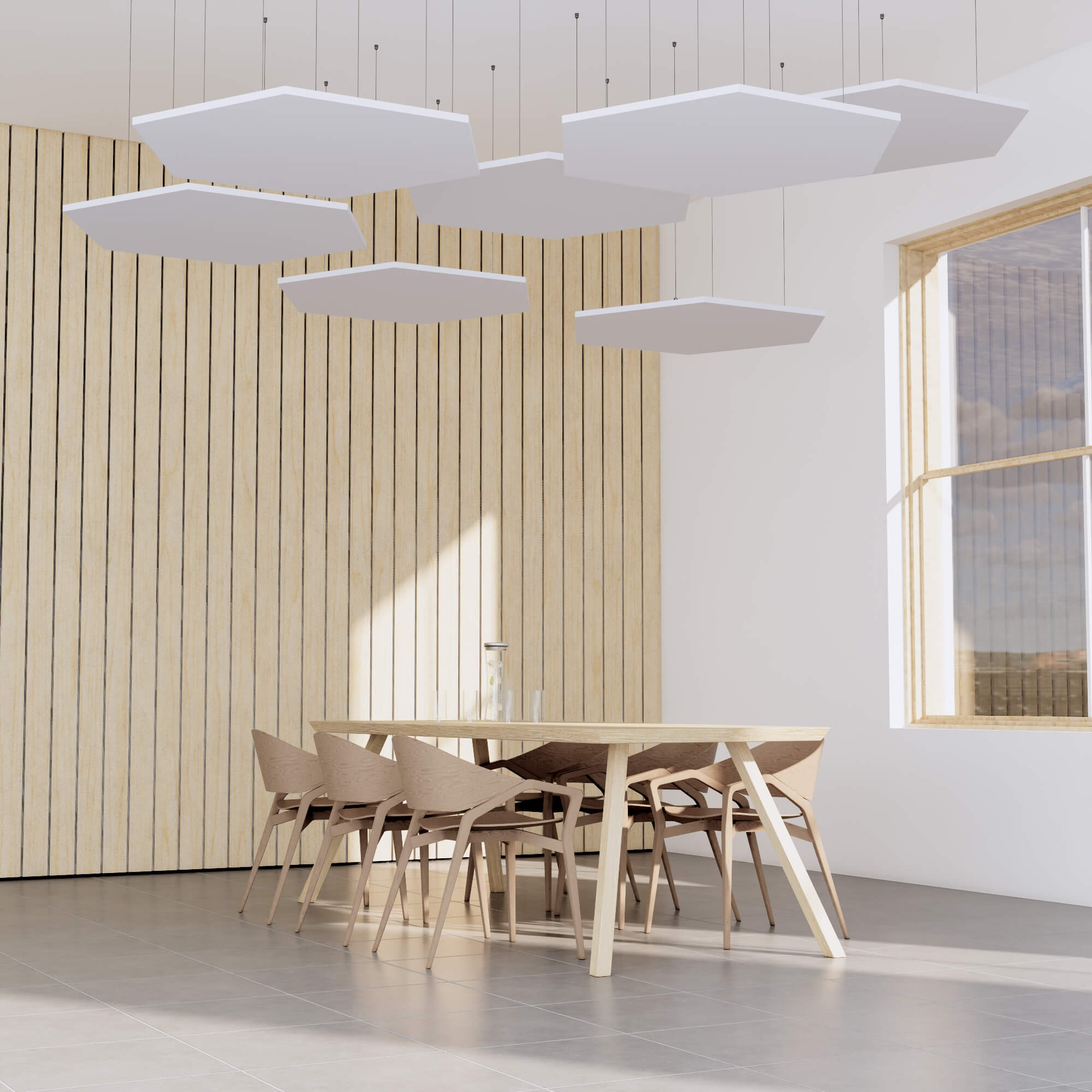
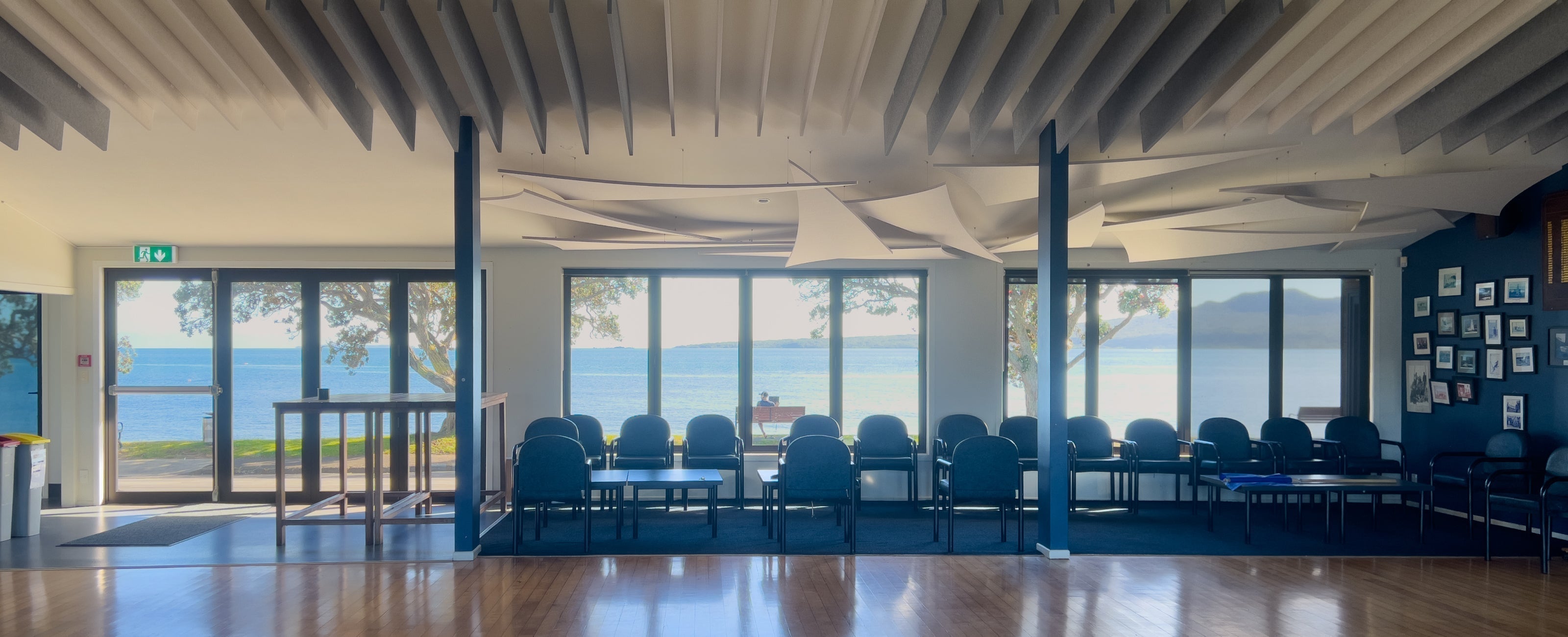
Suspended products provide absorption within the volume of the room. They suit high ceilings, exposed services, large vertical volumes and offices with limited wall space, and they give designers a way to integrate acoustic treatment into the architecture. Sound reaches both faces of a hanging element, so each one has more surface working for it.
dbsorb Acoustic Solutions offers dbBaffle™ and dbFin™ as linear baffles, Matrix™ baffles for small and large open spaces, Vista™ suspended panels and cloud-shaped baffles for a more sculptural ceiling. Browse the full suspended acoustic baffles collection.
Suspended Matrix baffles in Alpine white, hang above this conference space, adding absorption in the volume of the room and leaving wall area free for other uses. Their repeating lines double as an architectural feature of the ceiling.
Add Acoustic Screens
Acoustic screens give the office a spatial definition and sound absorption at the same time. They work around desks, workstations, collaborative areas and shared workspaces, creating a degree of separation without permanent walls.
The Hanging Screen from dbsorb Acoustic Solutions is a suspended acoustic partition. It comes in cut-through patterns, with print and custom-cut options for matching a brand or aesthetic. Performance improves when several screens are used across a space or near reflective surfaces. Line of sight can be managed too: a pattern can be blocked out where needed, a functional alternative to privacy film on glass pod meeting rooms. Each screen hangs from a glue-free FinLock™ and suspension wire system that allows height adjustment and reuse.
At Daikin's Auckland headquarters, hanging screens with organic cut-outs zone the open-plan floor without building walls. They absorb sound and give each area some visual separation while the floor plate stays open and light.
Create Dedicated Spaces for Calls and Collaboration
Some people speak loudly by nature, and some activities generate more speech than others: phone calls, video calls, informal conversations, group discussions and collaborative work. Acoustic treatment reduces the sound reflected and accumulated in the room, and it leaves speaking volume with the speaker. Dedicated spaces give the louder activities somewhere to go.
Phone booths, meeting pods, meeting rooms and collaboration zones each suit a different need. A single phone call fits a booth or pod, which frees conference rooms for the meetings that need them, and the main workspace stays more comfortable. dbsorb Acoustic Solutions has worked with XFrame, whose room-in-room meeting pods pair with a modular acoustic ceiling system that integrates dbsorb's X-Clip™ fixing. Read the XFrame case study
How Do I Improve the Acoustics in My Office?
A practical sequence works for most offices:
Listen first. Clap once at a quiet moment and note how long the sound lingers, then repeat in the busiest area.
Identify the reflective surfaces: glass, concrete, bare ceilings, hard floors and blank walls.
Separate the activities. Calls and video meetings that can move to a booth or meeting room relieve the open floor.
Add absorption where reflections concentrate, using walls, ceilings, suspended products or screens.
Confirm any formal requirements and product test data before specifying.
Bring in specialist input for larger or more demanding projects.
Do Acoustic Panels Work in Offices?
Yes. Acoustic panels can be effective in offices when they are selected, sized and positioned for the acoustic problem in front of them. They absorb part of the sound that reaches them, which reduces reflected sound and reverberation and improves speech clarity. How much difference they make depends on room volume, surface finishes, panel thickness, air gap, installation and the amount of treatment.
Panels are one component of an overall acoustic strategy. A treated wall improves part of a room, and the larger gains come from combining wall, ceiling, suspended and screen treatment with dedicated spaces for calls.
Case Study: A Clap Test You Can Hear
dbsorb Acoustic Solutions shared a before-and-after Reel of an Auckland meeting room following the installation of acoustic panels.
The room had become frustrating to use. Its high ceiling and hard surfaces allowed sound to reflect around the space, making conversations harder to follow and Zoom calls particularly difficult. The team's Wellington branch had even reached the point of saying, “We're sick of it, we can’t hear you people properly!”
dbsorb designed, manufactured and installed a custom acoustic treatment for the room. Installation started at 2:00pm and the room was complete by 3:40pm, with the glue-free clip system allowing the team to get straight back to using the space.
The difference is easy to hear in the Reel. Before treatment, the clap rings around the room as sound reflects from the hard surfaces. Afterwards, the reflections are noticeably shorter and more controlled.
A clap test is a simple way to hear reverberation for yourself. It isn't a substitute for professional acoustic testing, but it can give you an immediate sense of how much sound is lingering in a room.
Where Should Acoustic Panels Be Placed in an Office?
Placement follows the paths sound takes through a particular room, so the right positions come from understanding where speech travels and where it reflects. Positioning panels with a purpose gives better results than filling whatever wall space happens to be free.
Walls
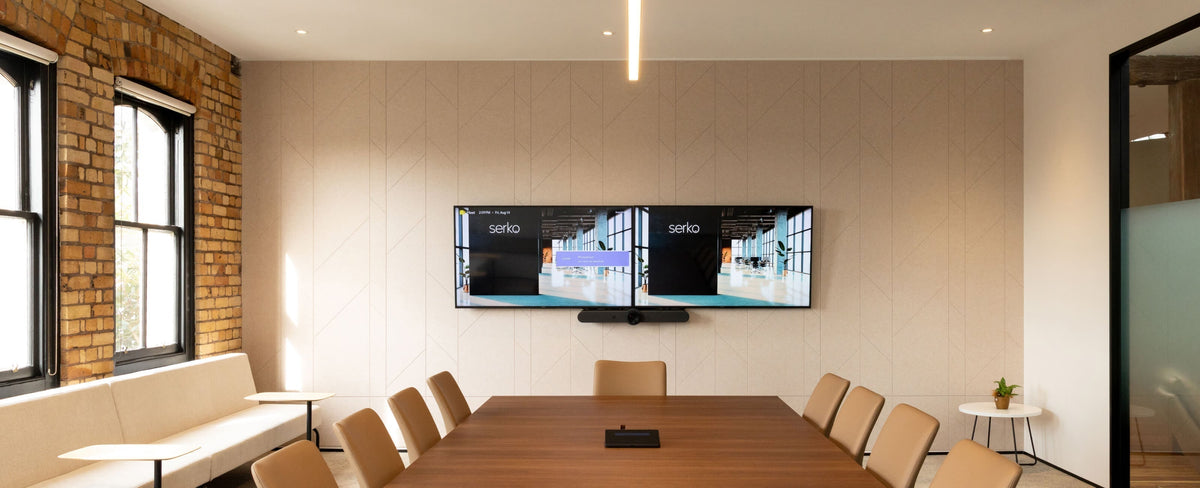
Walls suit the reflections and the speech that travel through the occupied zone. Meeting rooms with video conferencing are a good example, where the wall behind the screens is the surface every voice faces.
At Serko's Auckland headquarters, a grooved feature wall behind the video conferencing screens picks up where the carpet leaves off, absorbing sound that would otherwise bounce between brick, glazing and a white ceiling. The Dopra colour draws on the timber and leather, so the treatment reads as part of the room's material palette.
Carpet handles the floor, and a room with brick, large windows, a glass internal wall and a white ceiling still has plenty of reflective surface left. The wall treatment addresses those.
Ceilings
Ceilings come into play wherever the ceiling is a large reflective surface, which is common with exposed structure or hard soffits. Overhead treatment also leaves walls free for glazing, whiteboards and furniture.
Suspended Systems
Baffles, fins and suspended panels are particularly useful where there is substantial ceiling height or limited wall space.
They can also help integrate acoustic treatment into exposed architectural ceilings.
Around Workstations
Acoustic screens can provide local separation around desks and collaborative areas while contributing to sound absorption.
High-reflection surfaces
Glass, concrete, hard flooring, exposed ceilings and timber can all contribute to reverberation.
That does not mean every hard surface needs to be covered. Absorption can be introduced elsewhere, on solid walls, overhead or within the volume of the room.
The aim is enough absorption in the right places.
How Much Acoustic Treatment Does an Office Need?
There isn't a single percentage of wall or ceiling area that will work for every office. The amount of acoustic treatment depends on the room's size, shape, existing finishes, ceiling height, occupancy and how the space is used.
A useful starting point is to look at how much sound-absorbing surface the room already has. A carpeted floor, acoustic ceiling and upholstered furniture will behave very differently from a room dominated by glass, concrete, plasterboard and other hard surfaces.
The performance of the acoustic material matters too. NRC, or Noise Reduction Coefficient, is one measure used to describe how effectively a material absorbs sound. A higher NRC generally indicates greater sound absorption, although the result also depends on how the product is installed.
Why Panel Thickness and Air Gaps Matter
This is where thickness and air gaps become important. An acoustic panel installed directly against a wall behaves differently from one installed with an air cavity behind it. The construction can influence the frequencies the system absorbs and its overall acoustic performance.
For this reason, acoustic treatment should be specified according to the room and the desired acoustic outcome, rather than simply choosing a fixed number of panels.
The QuietKit™ example demonstrates why an acoustic system involves more than simply placing a soft surface against a wall. The relationship between the panel, cavity, mounting system and room all matters.
The QuietKit Reel explains why this works, and it pairs well with the clap test above: one lets you hear the difference, the other shows why the system performs. These figures belong to the products named. Other products in the range have their own ratings, and material, thickness, gap and mounting work together, so the tested configuration is the fair basis for comparing products. For a complete look at QuietKit, see the QuietKit product page.
Acoustic Treatment vs Soundproofing
Acoustic treatment and soundproofing solve different problems.
Acoustic panels absorb sound within a room, helping reduce reverberation and improve speech clarity. Soundproofing is concerned with reducing sound transmission between spaces and generally involves the building construction itself.
For an open-plan office where the main problem is voices, echo and accumulated background noise, sound absorption is the relevant starting point.
What Should You Look for When Choosing Office Acoustic Panels?
Performance is only part of the decision. In a commercial fit-out, the material, appearance, installation method and ability to adapt the space matter too.
dbsorb Acoustic Solutions manufactures acoustic products in New Zealand using PET-based acoustic materials, with products available in a range of colours, patterns, prints and configurations.
The range also includes glue-free mounting systems designed to make panels removable and adaptable, supporting fit-outs where spaces may change over time.
That gives architects, designers and project teams more flexibility to make acoustic treatment part of the design rather than something added at the end.
Vertical grooves bring warmth, texture and sound absorption to the white walls of a second Serko conference room, where carpet, a skylight and timber columns set the tone. The same panel that calms the acoustics also adds visual interest to an otherwise plain shell.
Performance data. Ask for NRC and, where available, frequency-by-frequency absorption results. Check the mounting configuration used for the test because installation can affect the result.
Indoor air quality. dbsorb Acoustic Solutions states that its panels use low-VOC or VOC-free materials and glue-free mounting systems to support healthier indoor air. Check the certificates that apply to the specific product.
Durability and maintenance. Offices are high-use environments, so consider impact resistance, cleaning and how easily a damaged module can be replaced.
Installation. Fixing method decides how cleanly a panel can be removed and reused when a tenancy changes.
Design. Colour, groove pattern, print and form determine whether a product sits comfortably in the fit-out.
Fire Performance
When people picture acoustic treatment, they often picture the familiar black acoustic foam used in recording studios and rehearsal spaces. While acoustic foam can provide sound absorption, some commonly used foam products can be highly combustible, particularly certain polyurethane foams. There have been serious fires around the world where acoustic foam has contributed to rapid fire spread, making fire performance an important consideration when specifying acoustic materials.
For commercial interiors, acoustic performance needs to sit alongside fire performance. The relevant classification depends on the product, its construction and how it is installed, so acoustic materials should be checked against the fire performance requirements of the specific project rather than assumed to be suitable based on their appearance or acoustic rating.
dbsorb Acoustic Solutions uses PET-based acoustic materials, with current product documentation listing ISO 9705-2003 Group 1 fire performance for products including QuietKit™, dbSilent Panel, dbTiles™, dbFin™ and dbBaffle™. For architects, designers and specifiers, fire performance is another reason to look beyond NRC when comparing acoustic solutions.
Materials, Sustainability and Installation
The material behind an acoustic solution affects more than its appearance. For commercial interiors, recycled content, emissions, durability, installation methods and what happens when the fit-out changes can all form part of the specification. dbsorb Acoustic Solutions manufactures its acoustic products in New Zealand using PET-based materials, with current product documentation listing up to 60% recycled content and GRS 4.0 across products including QuietKit™, dbSilent Panel, dbTiles™, dbFin™ and dbBaffle™.
Installation is another part of the equation. dbsorb's ReadyClip™ and FinLock™ mounting systems provide glue-free fixing options designed for fast installation and removal, avoiding the need for wet adhesives and associated curing time. The systems also support more adaptable fit-outs where acoustic elements may need to be repositioned or removed as a workplace changes.Sustainability therefore extends beyond the material itself. Using recycled content is one consideration, while designing products and fixing systems that can be removed, adapted and potentially reused or recycled can help support longer-term flexibility in commercial interiors.
What Are the Acoustic Requirements for an Office?
No single acoustic requirement applies to every office in New Zealand. What applies depends on the building type, occupancy, room function, tenancy arrangement, project brief, an acoustic consultant's assessment, applicable standards and building requirements, and any Green Star rating the project is pursuing.
When compliance is on the table, four things stay distinct. Product test results (NRC, fire classification) describe the product. Project-specific acoustic design shows how the product performs in the room. Regulatory or rating-tool requirements set the target. A final compliance assessment checks the finished project against that target. Compliance is confirmed at the project level, and no single product carries it on its own.
For projects with formal targets, engage an acoustic consultant early. Green Star guidance describes a qualified acoustic consultant as a member of the Acoustical Society of New Zealand or an equivalent recognised body. The Mason Clinic case study shows the approach on a healthcare project in Auckland: early modelling, material selection and coordination on a 5 Star Green Star Design & As Built NZ project.
Design Should Be Part of the Acoustic Solution
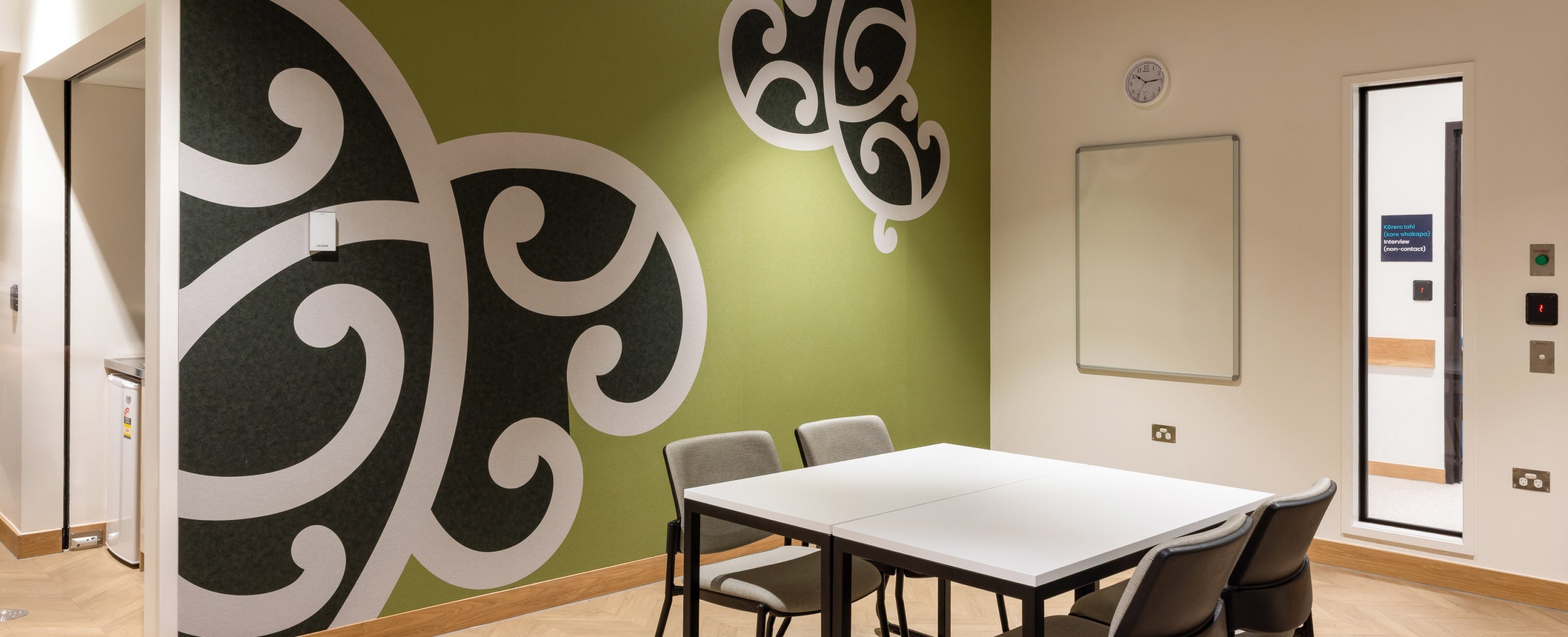
Modern offices are usually designed with care, and acoustic treatment can be part of the architecture from the first sketch. Colour, groove, print and form are all available as design tools. The palette runs from soft neutrals to deep hues and bright tones, V-groove cuts add depth, and timber print brings natural warmth without the weight of timber. Custom printing carries branding or artwork.
Seen from a diagonal, the grooved wall takes up the right third of the frame and shares its palette with the brick, timber and leather. Treated as a material choice from the start, the acoustic surface contributes to the room's design as well as its sound.
The same thinking extends to larger gestures. In the atrium of an Auckland shared workplace, dbsorb Acoustic Solutions worked with Jasmax on a dbFin feature wall using two colours and dozens of shapes in a layered composition that changes depending on where you stand.
At Fonterra's Hamilton office, printed baffles carry imagery supplied by the designer, and at Daikin's Auckland headquarters, printed panels turn company values into part of the conference room.
In a Daikin conference room, dbSilent Panels carry custom-printed graphics of the company's values. Speech clarity and brand storytelling share the same surface.
Designing Better Office Acoustics With dbsorb Acoustic Solutions
dbsorb Acoustic Solutions is an Auckland manufacturer of architectural acoustic products, working where acoustic performance, architectural design and sustainable innovation meet. Products are designed in-house and made in New Zealand from recycled PET materials, with glue-free, demountable mounting systems that keep installs clean and reversible.
For an open-plan office, a typical scheme draws on several families at once: wall systems such as QuietKit™ and dbGroove for reflection points, ceiling products such as dbGrid™, dbMesh™ and dbSoffit™ for hard ceilings, suspended baffles and panels for high volumes, and Hanging Screens for zoning. The company also works on bespoke pieces where a project calls for something custom. The open-plan office collection groups the options, and the specification guide covers the details for architects and designers.
Better Acoustics Can Support Better Workspaces
The team member who reaches for headphones every afternoon is responding to the room. The goal of acoustic treatment goes beyond a quieter office. It is a workplace with:
conversations that carry clearly
meetings people can join without straining
concentration that comes easily at a desk
collaborative areas that stay usable
calls and video meetings with spaces of their own
architecture that still feels intentional
If your office needs that kind of change, dbsorb Acoustic Solutions can help create bespoke acoustic solutions for commercial spaces. Explore the office acoustic solutions, request a colour sample, or contact the team to talk through your space.
 Skip to content